 Low-maintenance, lusciously textured and lush groundcovers can turn a backyard into a patchwork of greenery. They now blanket most of my yard, cutting my work in half and saving me the countless hours I would otherwise spend mowing, string-trimming and edging. With the right groundcover plants, you too can replace your mulch, lawn and weedy flower bed with something that actually works.
Showing posts with label landscape design. Show all posts
Showing posts with label landscape design. Show all posts
8 Reasons to Plant Groundcovers
Low-maintenance, lusciously textured and lush groundcovers can turn a backyard into a patchwork of greenery. They now blanket most of my yard, cutting my work in half and saving me the countless hours I would otherwise spend mowing, string-trimming and edging. With the right groundcover plants, you too can replace your mulch, lawn and weedy flower bed with something that actually works.
How to Attract House Hunters with Curb Appeal

Big news! Mrs. Rainforest Gardener and I are moving into our very own home... and yes, there will be plenty of room for a garden. To celebrate our big step and give me more time to pack, I'm sharing a guest post from Zillow on that enigmatic thing called curb appeal; something that most gardeners wrongly assume they already have. Whether you're also thinking of moving or just want to keep up appearances, here are some tricks to make your home irresistible.
Tropical Color in the Summer Garden

How To Plant a Lush Drought Tolerant Garden

Garden Design Tips: Borrow a View!

Things I Have To Do This Fall

.
Why I Plant Densely

.
Anticipation in My Tropical Landscape
If patience is the food that fortifies gardeners in a journey to botanical bliss, anticipation is the blend of savory spices that pulls us out of bed every morning with the promise of inevitable progress. I often have dreams in which I awaken years later to come upon my garden complete with a mature canopy of trees and an understory jam packed with gingers and bromeliads. Its often hard to see the potential in plants without a little imagination and optimism. For example, look at how my clump of Alocasia "California" has grown! Please pardon all the crappy cell phone shots.


Since I live thirty to forty minutes away from my parent's house, I'll often go a week or so without witnessing the drama of my plants unfold. Sometimes when I come back to the garden everything has already changed: Trees have grown taller, bananas have put out new leaves, and vines have taken claim over new territories. The downside is that when a plant is struggling, its often too late to save it from pests or drought and all I see is a withered form stretched out over the soil or a present from my dog right in the cup of a bromeliad. However, everything fills back in before you know it, and you learn to pick plants that grow taller than your dog's legs.


The most important plants in my garden are trees, if only for their obvious role in what we perceive as a "rainforest". I could have all sorts of tropical plants in the landscape, but it would be pointless without that extra vertical dimension to add mystery and depth; to make the visitor anticipate what's around the corner. If everything was laid out in flat and static beds without any curves or obstruction to our view, what would be there to satisfy our curiosity?
Often the only thing that gets me out of bed in the morning is curiosity. I rejoice over every new leaf that opens on my balcony, and I check for new stems or germinated seeds every day, as if missing the event would make me wonder all day. Its not a necessity to do these things, just a daily affirmation of the insistence of life to continue growing. To those of you who feel that every day is a repeat of the last hundred mundane ones, I recommend watching a plant and recording its growth even if only as an afterthought on the way out the door or on your lunch break. Just be sure to pick something that won't get hacked down like a hedge or a crape myrtle, because let me tell you, that gets depressing.


This is the planting site a little over two years ago, before the alocasia was planted as a 3 gallon plant from Lowes.

After flourishing for a little over a year, the record breaking winter ended up killing all the leaves and even damaging the stems.

This is the clump at present, in mid July. It is now up to my nose.

Here is an eye level view from behind the clump. Why don't more people grow this around here?

This is what the garden along my fence looked like a little over a year ago in early spring. I have since pulled up the creeping fig under the birdbath just in case it gets a little too vigorous. Notice the little tabebuia tree to the left. The other trees such as bottlebrush and weeping yaupon holly are to the left and right of this scene.

Now look at the explosion of growth taking place right now! The firespike, gingers, pentas and tibouchina have returned, the tabebuia in the back is growing like crazy, and there are some new faces too! Heliconia "Costa Flores" overwintered from last fall, and a purple crinum forms a focal point in the middle. The trees will, in time, form a protective canopy over the understory but by anticipating that happening I've made sure that the understory also thrives in shade.

The back corner is frequently flooded, so anticipating this, I planted everglades palm, false cardamom ginger, philodendron and ti plant, and all of which have proven to handle wet feet in my garden. Behind those I planted trees over the last couple of years. Three native yellow anise trees will provide evergreen foliage and a shady canopy, while a native weeping yaupon holly ties in with the other two I have planted elsewhere in the backyard. I also have three bottlebrushes in the backyard, as well as one in the front. I'm aiming for consistency, so that I can create a more believable "forest" by the time it matures.
Often the only thing that gets me out of bed in the morning is curiosity. I rejoice over every new leaf that opens on my balcony, and I check for new stems or germinated seeds every day, as if missing the event would make me wonder all day. Its not a necessity to do these things, just a daily affirmation of the insistence of life to continue growing. To those of you who feel that every day is a repeat of the last hundred mundane ones, I recommend watching a plant and recording its growth even if only as an afterthought on the way out the door or on your lunch break. Just be sure to pick something that won't get hacked down like a hedge or a crape myrtle, because let me tell you, that gets depressing.

An agapanthus bloom stands guard over the entrance to the forest. What lies beyond?
Plant Profile - Lady Palm, Rhapis Excelsa
Lady palms are among the most elegant and graceful palms for the tropical garden, and are perfect for tight spots where other, less ladylike palms would quickly overstep their boundaries.

History
Rhapis has a long history of cultivation beginning in China and ending up in Japan during the tokugawa shogunate in the early 1600's where it became a prized collectors item, starting a long line of prestigious clones that can be bought for lofty prices. Many of these specimens are diminutive, and even more sought after are the variegated ones. The size isn't just a characteristic of the individual strain, but is also affected by its cultural differences such as using small containers and root pruning, lending an appropriate resemblance to bonsai. If growth is unrestricted, they can still attain a decent size.
Landscape Uses
A slightly more affordable option to the heirloom Japanese dwarfs is to grow the species in the landscape, utilizing its upright habit and graceful multiple trunks. I recommend using it near entryways where its form can be admired, and where few other palms will really fit.
 I see so many of the (less cold hardy) pygmy date palms planted in front yards where their tiny crowns expand toovertake the sidewalk, poking passerby with prickly spines! The same goes for the king sago, also painful to brush up against. The builders of our house made this mistake, and I'll have to remove it before long. So why not replace it with a lady palm? Its important to note that the roots can be invasive, but because of its slow growing nature you can usually prune the shallow stolons before they get too close to a structure.
Any Asian themed garden just begs for a foxy lady palm! Even the untrained eye will subconsciously sense the affinities between rhapis and bamboo, except lady palm is way better behaved. Try planting it alongside kurume azaleas with Japanese birds nest ferns underneath a loquat tree in homage to its Japanese (and Chinese) roots!
Another way to use rhapis excelsa or its relatives is to grow it as a hedge in a partly shaded site, and I'm sure it will be the most glamorous hedge money can buy, bringing me to my next topic...

Buying Lady Palms
They are notoriously expensive, but well worth the money. The reason they cost so much comes down to their means of propagation, which is limited to division. This wouldn't be a big deal except that lady palms can be mind numbingly slow plants, and not all divisions make it after the breakup, so I recommend picking the plant with the most suckers if you're shopping around since they'll multiply quicker. If you're looking for a great deal, it pays to do your homework and play the field, checking out the big box retailers, garden centers, as well as plant shows and plant sales where the deals can surprise you.
Culture
As a rule they don't like too much sun and prefer a partly shaded to fully shaded situation to look their best. Indoors they are among the more shade tolerant houseplants you can grow, but they will surely thank you with faster growth if they get a lot of indirect light.
 Lady palms are notorious for being sensitive to the minerals in tapwater, but my potted specimen on the balcony handles our awful city water just fine, as long as I let the heavy summer rains flush out the excess salts from time to time. Keep the soil evenly moist but not soggy, and don't let them dry out too often.
 Pruning is a matter of aesthetics and preference, and you can choose to let the suckers grow to cover the plant with top to bottom leaves or prune out the lower trunks with clean loppers to better expose the architectural trunks. The most preferable arrangement for me is to let three distinct canopies form, to better imitate nature.
Here's my favorite part about these heroines of my garden: They're cold hardy into zone 8 and can take a hard freeze or two. I've even heard reports of them growing back from the roots in colder situations, so they may be hardier with a little protection. There aren't many palms that can compete in the small palm category outside the tropics, and even bamboo palm is a close second. For a tropical looking palm in a residential landscape, its lady palm, hands down!

Looks like I took lady palm a little too literally in my little illustration.
Sources
Timber Press Pocket Guide to Palms by Robert Lee Riffle
All About Palms by Ortho
A Handbook of Landscape Palms by Jan Allyn
My Garden in the Big Picture

Lately I've been focusing on the big picture in my life, focusing on my portfolio and even deciding to finish my graphic design degree. In order to do this I have had to take a position with more flexibility and less hours at my day job, which also translates to less money for plants and long drives to my parent's place where I garden.
I find it hard to focus on more than one thing, so its been difficult to balance a 45 hour job, freelance design, doing my laundry, and a blog on top of that. As a kid I was the one who was too focused on the pretty butterfly landing on the soccer ball to even learn how to play the darn game, to give you an idea.
I love the show "Glee", but it seems like every episode Mr. Schuster comes up with another cheesy theme to tie the songs and plot together. While I won't break out in song and dance, I find it appropriate to tie this post together with the theme "Big Picture".
I have been with the love of my life for over five years and we figured we might as well get married next year. Eventually I'll get to share my excitement for life with the open mind and ears of our very own child. Its definitely time for me to focus on the big picture and finish my degree so that I can have a fulfilling career and be able to support a family. I'm not necessarily quitting or even taking a hiatus from blogging, I just consider you guys my friends by now and want you guys to know where I'm at these days, and why I've been laying kind of low lately.
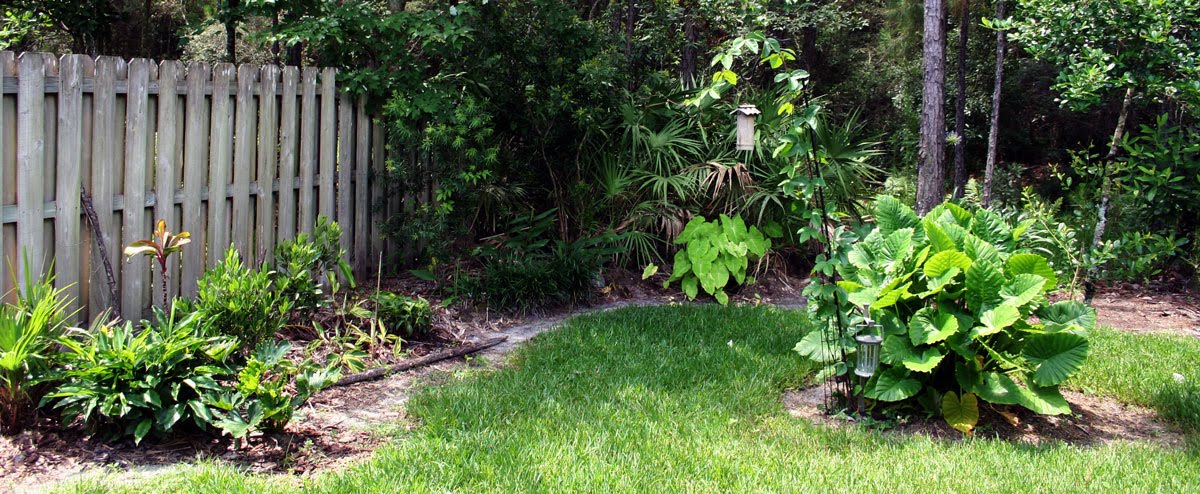
Enough sappy crap, back to the garden stuff! Although I love taking closeup shots, my favorite garden photos to look at are wide angled shots of the whole shebang... this way I can get inspiration for garden design, as well as see how other's gardens are doing.
Above is a panoramic shot of my garden right now, and that empty spot is where my variegated ginger got knocked back this winter. I keep having to remind myself of how lush and full they'll be in time, but for the time being its just kind of an eyesore. There's a good sized area where my groundcover of "evergreen giant" liriope was killed by my dog too, so I just have to look at it as a test of my patience.

Here's another more or less panoramic shot, and you can see the butterfly ginger reaching out over the creeping liriope in the back, doing much better than last year. Finally, its getting too dense for the dog to destroy!


Up above I've got a shot from the woods, with a mound of agapanthus in the foreground, my huge clump of alocasia "california" in the middle, and an assortment along the fence. To the right is a rather harshly lit view along the fence thrown in for good measure. I also want to note that the area around the birdbath is pretty empty for the time being, no thanks to the bananas that upped and died. I'm considering an affordable bottlebrush behind the birdbath, which would also help protect the crown of the picabeen palm. Besides, if I want to give the feeling of a rainforest, the more trees the better!
Now lets have a look at the courtyard garden...

Theres a lot to go over here! The bottlebrush and pineapple guava have finally hit their stride, and will eventually help shade this sunny patio. The lady palm and chamadoreas will take a while, but they'll also get taller someday, providing a little extra shade as well. The bromeliads are all doing great, and producing pups to boot!

Once again, Noel, African Aussie and Danger Garden... you won something so email me at "steve_asbell at yahoo.com" (replace the "at" with @)
$50 Gift Card Giveaway!

MODERN TROPICAL LIFESTYLE GIVEAWAY!
CSN Stores is collaborating with The Rainforest Garden for a $50 gift card giveaway! You can use it towards LED lighting to light up your garden, cooking utensils, you name it!
All you have to do is leave a comment to this post to enter, and I'll randomly pick the winner on May 31st, Memorial Day. If you become a follower of my blog or make a link to this site or contest, I will enter you twice!
A PLANT GIVEAWAY TOO!
I'm about to make things a bit more interesting though by introducing a contest of my own, in which you will pick one product from any of CSN's stores that you feel embodies the "Modern Tropical Lifestyle" theme. This could include pillows with bright modern prints, modern and sleek teak dining sets, oven mitts, or possibly some garden lighting or water features. Bright, Exuberant and maybe a little retro are all good qualities to look for.
Copy and paste a link to the product in your comment, explain your decision, and I will pick my favorites for a post on "Modern Tropical Living". My favorite entry will receive a goody like an aechmea "blue cones" offset or a hidden ginger rhizome!
There are lots of stores in which to make your choices, but here are some starters. cookware.com, allmodern.com, alloutdoordining.com and everyfountain.com. Here's a whole list of all the stores.
I'm really excited to give back to you guys after you've supported me so much! The Rainforest Garden has grown so much in just several months and I have you to thank!
Chamaedorea Radicalis and Microspadix

They are native to a transitional climate in Mexico that experiences frost on occasion but still has a wealth of plants with a tropical background. I would love to do some hardiness research on some of the other plants in the El Cielo Biosphere Reserve since they may have potential for the garden and hybridizing!

Chamaedorea Radicalis
In the first two pictures above, this is known simply as Radicalis palm to those lucky enough to be acquainted to its many charms. Deep green pinnate leaves arise from an underground trunk in most cases, but aerial forms have bamboo like trunks and can gain considerable height. They prefer shade, are hardy to at least 20 degrees with no damage but durable in zone 8 as well, and are versatile when it comes to moisture requirements. I have grown it in flooded soil to no ill effect before deciding to rip them out and try them in a dry spot under the eaves of the house. Since they come from the chaparral oak forest of Mexico, they can tolerate considerable drought. If you live up north, these make great container plants that can take more cold than most houseplants if left outdoors, so they can be left outside for the majority of the year! Just bring it inside when its under 20 degrees to be on the safe side.
If this wasn't a great enough plant already, bright red berries form on female plants in pendant clusters, brightening up your shady garden and attracting birds. The fronds of Radicalis Palms are even exported from Mexico to the United States for floral arrangements!

Chamaedorea Microspadix
A close cousin of radicalis palm, this one is a must for an Asian look and is a perfect replacement for bamboo where space is an issue. Just as hardy as radicalis palm, this one is definitely the more graceful of the two and lends itself to intimate areas where its berries and bamboo-esque trunks can be appreciated. It is a clumping palm, but isn't so vigorous that it can't be kept in check. The photo on the left was taken at the FSCJ south campus in Jacksonville. These are best grown from fresh seed.Visit these sites for more info!
Floridata: Chamaedorea Radicalis
Floridata: Chamaedorea Microspadix
Underutilized palms for Central Florida
El Cielo Biosphere Reserve, Mexico (This is where these palms grow!)
Subscribe to:
Posts (Atom)